
Table of Contents
- How to remove dog hair from clothes quickly: first steps before washing
- Best tools for removing dog hair: gloves, lint rollers, and vacuums
- How to wash clothes with dog hair without ruining the fabrics
- Home hacks for removing pet hair from delicate clothing
- Differences by fabric type: wool, synthetic, and textile fiber
- Prevention and maintenance to avoid hair buildup
- How to remove dog hair from clothes quickly: mistakes you should avoid
- Conclusion
- Frequently Asked Questions
Last updated: September 10, 2026
How to remove dog hair from clothes quickly: first steps before washing
The direct answer: to quickly remove dog hair from clothes, start with the dryer, not the washing machine. A short dryer cycle before washing loosens hair fibers that the drum alone won't remove.
Hair adheres to fibers through mechanical friction and static electricity. The washing machine only addresses the former; that is why pre-drying is critical.
The short dryer cycle that loosens hair from fibers
Ten minutes in the dryer on medium heat, without fabric softener, is enough to detach a good portion of the hair before it enters the wash drum. Laundry guides on handling pet-hair-covered textiles recommend this short step precisely because it improves the efficiency of the subsequent wash.
The hot air and tumbling open the scales of the fiber, and the hair loses its grip. Take it out, shake the garment, and you will see how much hair falls off on its own.
Static and its effect on hair adhesion to fabric
Static electricity is hair's invisible glue. When two fabrics rub together, one gives up electrons and the other gains them; that charge attracts any light fiber. Synthetics generate more static than cotton, which is why hair grips to a fleece with a tenacity it doesn't show on a bedsheet.
If you remove the static charge first, the hair stops fighting you.
Best tools for removing dog hair: gloves, lint rollers, and vacuums
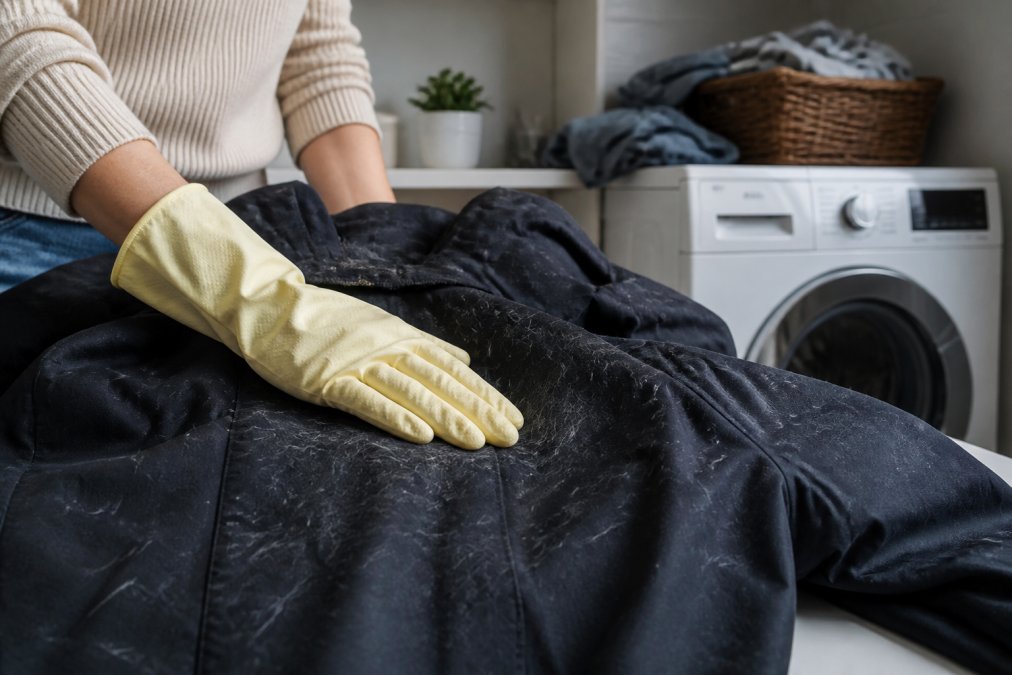
The best tool for removing dog hair from clothes is the rubber glove, followed by the sticky lint roller, and for large surfaces, a vacuum with an upholstery nozzle. The difference between solving it in thirty seconds or five minutes lies in choosing the tool according to the mechanics of the hair, not habit.
How each tool works (and why it matters)
- Rubber or silicone glove: the friction lifts the hair without breaking the fiber. The rubber generates a triboelectric charge that attracts the hair to the glove. It works dry, rinses under the tap, and is the fastest option for garments you are already wearing. A glove with deep ridges performs better than a smooth one.
- Lint roller: ideal for last-minute touch-ups and delicate fabrics. It uses up sheets, so reserve it for small surfaces. Use short strokes and lift the roller with each pass; dragging it only redistributes the hair.
- Vacuum with upholstery nozzle: the only realistic option for a sofa, car seat, or carpet; it is not worth it for loose clothing. The nozzle should have soft bristles to avoid snagging the weave.
- Electrostatic glove: attracts hair via charge, not adhesive, and is reusable indefinitely. It works better on synthetics than cotton, because they retain more charge.
- Natural bristle brush: for knitwear and wool, it lifts hair without breaking the fiber. Not useful for severely tangled hair or flat fabrics like nylon.
Comparison table by scenario
| Tool | Mechanism | Best for | Limitation |
|---|---|---|---|
| Rubber glove | Friction + triboelectric charge | Clothes worn, daily use | Does not reach seams |
| Lint roller | Direct adhesion | Delicate fabrics, touch-ups | Consumable, small surface |
| Vacuum w/ nozzle | Suction + bristles | Sofas, cars, carpets | Not for loose clothes |
| Electrostatic glove | Electrostatic charge | Synthetics, repeated use | Less effective on cotton |
| Natural bristle brush | Mechanical lifting | Knits, wool | Not for heavily tangled hair |
How to wash clothes with dog hair without ruining the fabrics
Washing clothes with dog hair requires lowering the temperature and increasing the rinse. Hot water binds hair proteins and skin oils to the fiber. Cold water, a gentle cycle, and an extra rinse solve most cases.
Separate by color and texture before throwing everything into the drum: a wool garment that drags hair from a synthetic towel comes out worse than it went in.
White vinegar, fabric softener, and dryer sheets: what works and what doesn't
White vinegar works; fabric softener does not. Half a cup of white vinegar in the softener compartment relaxes the fiber and neutralizes the static that keeps hair stuck. Softener leaves a waxy film that traps more hair in the next use.
Dryer sheets reduce static but leave chemical residue. Use them sparingly and never together with vinegar in the same cycle.
| Method | What it does | When to use it |
|---|---|---|
| White vinegar | Relaxes fiber and cuts static | Every wash of hairy items |
| Fabric softener | Leaves residue that traps hair | Avoid on pet-prone clothing |
| Dryer sheets | Reduces static with chemicals | Only in occasional dry cycles |
| Extra rinse | Washes away detached hair | Heavily hair-laden items |
Home hacks for removing pet hair from delicate clothing
For delicate clothing, wide adhesive tape is the safest tool. Wrap a few turns around your hand with the sticky side out and press gently, without dragging. Silk and lace cannot tolerate harsh friction, but they do handle point contact: the lighter the pressure, the less risk of snagging a thread.
A hair dryer with cool air also works. Aim the cold blast at a low angle, and the hair will fly off before static can trap it again. Do this near a window or outdoors: cold air does not set hair proteins like heat does.
A natural bristle brush, used dry, lifts hair from knitwear without damaging the fiber. For silk, neither the brush nor the rubber glove is a good idea: it is a protein fiber and friction marks it permanently.
Differentiation by fabric: the angle almost no one covers
Most articles treat delicate clothing as a single category, but silk, fine wool, and lace react differently to hair and each removal method.
- Silk: protein fiber, smooth surface, very sensitive to friction. Hair adheres more by static than by friction. Use adhesive tape with light touches or a cool-air hair dryer from a distance. Never use a rubber glove or brush.
- Fine wool (merino, cashmere): open scales that trap hair like natural Velcro. A damp rubber glove works, but with minimal pressure. Lay flat to dry is mandatory. Never use strong adhesive rollers or stiff-bristled brushes.
- Lace and textured fabrics: hair hides in the gaps. Tape wrapped around a wooden toothpick reaches better than your hand. A cool-air dryer helps expel hair from the cavities.
- Delicate synthetics (polyester chiffon, synthetic satin): the problem is pure static. A dryer sheet rubbed over the garment before wearing it reduces the charge and stops the hair from sticking.
Static as a root cause (and how to neutralize it without chemicals)
Hair sticks to clothes due to mechanical friction and static electricity. In delicate clothing, static dominates because the fiber is smooth and offers no mechanical grip. Neutralizing the charge before handling the garment cuts the work in half.
Home methods to neutralize static without commercial products:
- Diluted white vinegar: one part white vinegar to three parts water in a spray bottle. Lightly mist the garment inside out and let it dry. Acetic acid relaxes the fiber and dissipates the charge.
- Used dryer sheet: rub a previously used dryer sheet on the inside of the garment. The minimal residue reduces static without leaving visible marks.
- Ambient humidity: static spikes with dry air. Hanging the garment in the bathroom after a hot shower reduces the charge naturally.
- Metal clip: running a metal clamp or paperclip over the garment discharges the accumulated electricity. It is the fastest trick and leaves no residue.
Differences by fabric type: wool, synthetic, and textile fiber
The type of fabric determines which method works and which ruins the garment. Wool has open scales that trap hair like natural velcro; synthetic attracts it through pure static; cotton is the most forgiving.
- Wool: never use a strong adhesive roller or stiff-bristled brush. Use a damp rubber glove and dry flat.
- Synthetic (polyester, fleece, elastane): the problem is static. White vinegar and dryer sheets are your allies.
- Cotton and blends: can tolerate almost anything. Use a vacuum with a soft nozzle and regular washing.
Prevention and maintenance to avoid hair buildup
Prevention starts outside the laundry basket. Brushing your pet daily reduces the hair that gets into the environment and ends up on your clothes.
After every wash, check the washing machine’s lint filter and clean the door seal with a damp cloth. Hair accumulates there and re-deposits itself on the next load.
How to remove dog hair from clothes quickly: mistakes to avoid
Mistakes are repeated with almost comical consistency. Avoiding them saves you time and clothes.
- Wash first and dry later. Reverse the order: short dryer cycle, then wash.
- Using fabric softener "so it doesn't stick." It does exactly the opposite.
- Hot water to "disinfect." It sets the hair and odor into the fiber.
- Overloading the drum. Without space, water doesn't circulate and the hair doesn't leave.
- Ignoring static. It is the root cause of the adhesion.
- Scrubbing hard on delicate fabrics. It breaks the fiber before loosening the hair.
If you have allergies, add one step: an extra rinse and full drying before putting away. Residual hair and dust are what trigger symptoms, not the garment itself.
Conclusion
Pet hair on clothes is a physics problem, not one of brute force: static and friction, in that order. Solving it quickly means a short dryer cycle first, rubber glove after, and white vinegar in the wash.
At Mi Tienda 4, we have the tools that make this process simpler: the Pet Electrostatic Hair Removal Glove ($12.99), which traps hair via electrostatic charge without chemicals or batteries, and the All-in-One Grooming & Vacuum System ($89.99), which collects hair while you brush your pet and prevents it from ever reaching your clothes. Try it and stop fighting against hair in every wash.

Frequently Asked Questions
What is best for quickly removing dog hair from clothes?
The combination of a 10-minute short dryer cycle with a rubber or silicone glove is the fastest way to detach hair before washing. The dryer loosens the fibers and the glove traps the hair through friction. If you prefer a reusable tool, the Mi Tienda 4 electrostatic glove attracts hair without chemicals or batteries for $12.99.
How to wash clothes with dog hair so it doesn't stick more?
Before washing, run a short dryer cycle on cold air to detach the hair. Then wash with cold water and add half a cup of white vinegar to the rinse cycle. Avoid excessive fabric softener because some formulas attract static electricity and cause hair to adhere more strongly to the textile fiber.
Which homemade tricks for removing pet hair really work?
The most effective ones are wide adhesive tape for small garments and a rubber glove for large surfaces. White vinegar in the rinse helps reduce static.
How to prevent clothes from getting full of dog hair at home?
Brush your pet daily and vacuum the fabrics where they lay. Keep the washing machine's lint filter clean after every wash and dry clothes with dryer sheets to reduce static electricity. If hair builds up a lot during brushing, an integrated vacuum system like the All-in-One Grooming & Vacuum System from Mi Tienda 4, for $89.99, collects hair instantly.