
Table of Contents
- Early signs of separation anxiety in puppies
- How long a puppy can be left alone based on its age
- Routine for leaving a puppy home alone without stress
- Toys to reduce anxiety in dogs: environmental enrichment
-
Gradual training in solitude: the 5-minute protocol
- Prior preparation: the factor that decides success
- The step-by-step protocol with progress criteria
- Using monitoring cameras: how to evaluate without interfering
- Data interpretation: what the recording really tells you
- The mistake of interactive cameras with treat dispensers
- When the protocol doesn't work: warning signs
- Anxiety or boredom: how to differentiate them and act
- When to seek professional help for separation anxiety
- Frequently Asked Questions
Last update: September 8, 2026
Between 20% and 40% of dogs suffer from separation anxiety disorder, according to the Anicira Veterinary Center. The good news: in puppies, this problem can be almost completely prevented with a proper routine. In this guide, we explain how to avoid separation anxiety in puppies from day one, using a practical protocol that combines ethology, desensitization, and positive reinforcement. Separation anxiety is a behavioral disorder that manifests as extreme distress when a dog is left alone, and early prevention is far more effective than any subsequent corrective treatment.
Early signs of separation anxiety in puppies
Detecting the first signs makes the difference between a passing annoyance and an entrenched disorder.
The most common signs include excessive vocalization, destructive behavior focused on doors and windows, inappropriate elimination in a puppy that is already house-trained, panting, excessive drooling, and disproportionately effusive greetings. Hyper-attachment (following you around the house incessantly) is an early risk factor.
How long a puppy can be left alone based on its age
A puppy's ability to handle being alone depends on its age and bladder control. A puppy 8 to 10 weeks old needs to go out every 2 hours; at 3-4 months it can hold it for about 3-4 hours; and from 6 months on, most can tolerate 6-hour stretches if the routine is consistent.
Exceeding these limits leads to accidents that increase their stress. Respect these times and you will be building a solid foundation for preventing anxiety.
Routine for leaving a puppy home alone without stress
Effective prevention does not begin the day you return to work: it begins the day the puppy arrives home. What you do between week 8 and week 16 of life will determine how it manages solitude for the rest of its adult life.
Weeks 8-10: The safety and secure attachment phase
During these first weeks, the goal is not to train solitude, but to build a foundation of safety:
- Establish a safe zone (playpen or puppy-proof room) with their bed, water, and elimination area with puppy pads. This zone must be a positive space where they receive treats and meals, never a place of punishment.
- Practice micro-absences of 30 seconds to 2 minutes while the puppy is distracted with a stuffed toy. Leave the room without announcing it and return before the toy is finished. The goal is for the puppy not to even notice you left.
- Ignore initial whining during these micro-periods. If you return every time it whines, you teach it that whining brings you back. If the whining persists for more than 2-3 minutes, return without making eye contact and resume the exercise later.
Weeks 10-12: Introduction to structured solitude
The puppy now feels safe in its new home. It is time to structure longer absences:
- Implement the rule of 5 minutes per month of age, but with an important nuance: it is not about leaving the puppy alone and waiting, but doing so after a physical exercise session and an opportunity to eliminate. A tired puppy with an empty bladder is much less likely to become distressed.
- Create a 15-minute pre-departure routine that is always identical: a short walk, fresh water, a stuffed toy in the safe zone, and departure without saying goodbye. Predictability reduces cortisol because the puppy knows exactly what to expect.
- Record 10-15 minute sessions with your phone or a monitoring camera to evaluate actual behavior, not what you imagine it does. Many owners are surprised to discover that their puppy falls asleep 3 minutes after they leave.
Weeks 12-16: Progressive extension and setback management
This is where many protocols fail: they increase the time too quickly and the puppy experiences a stress spike that reverses weeks of progress. The golden rule is to increase only 10-15% of the current time every 3-4 days, provided the puppy has been calm in the last few sessions.
| Age | Max time alone | Progress sign | Setback sign |
|---|---|---|---|
| 8-10 weeks | 30-45 minutes | Sleeps or plays quietly | Vocalizes more than 5 mins in a row |
| 10-12 weeks | 1-2 hours | Stays in zone without trying to escape | Eliminates in zone despite going out before |
| 12-16 weeks | 2-4 hours | Calm greeting upon return | Excessive drooling or panting upon return |
| 4-6 months | 4-6 hours | Seeks toys during absence | Tries to escape from the safe zone |
Handling setbacks: the 3-3-3 rule
Puppies do not progress in a straight line. It is normal for a week of excellent behavior to be followed by a day of regression, especially after changes in routine, vet visits, or very active days. The 3-3-3 rule is useful for interpreting these patterns:
- 3 days to adapt after any significant change
- 3 weeks to establish a new routine
- 3 months to solidify the habit
If your 14-week-old puppy that tolerated 2 hours alone starts whining at 30 minutes, do not abandon the protocol: reduce the time to 45 minutes for 3-4 days and gradually increase it again. Punishing the setback or lengthening the time "so they get used to it" only reinforces the anxiety.
The variable almost no one mentions: your own post-return behavior
The moment of your return is as important as that of your departure. If you respond with the same energy to their excitement, you teach them that your absence was a stressful event. The correct protocol is:
- Enter without making eye contact or speaking
- Leave your keys and coat in their place
- Wait for the puppy to calm down (sitting or lying down)
- Only then, greet them calmly and with a treat
This pattern, repeated consistently, teaches the puppy that your return is a predictable and calm event, not a reward for having survived your absence.
Toys to reduce anxiety in dogs: environmental enrichment
A busy puppy is a calm puppy. Environmental enrichment turns your absence into an opportunity for play. Interactive toys that dispense food are especially useful because they combine mental stimulation with a calming activity.
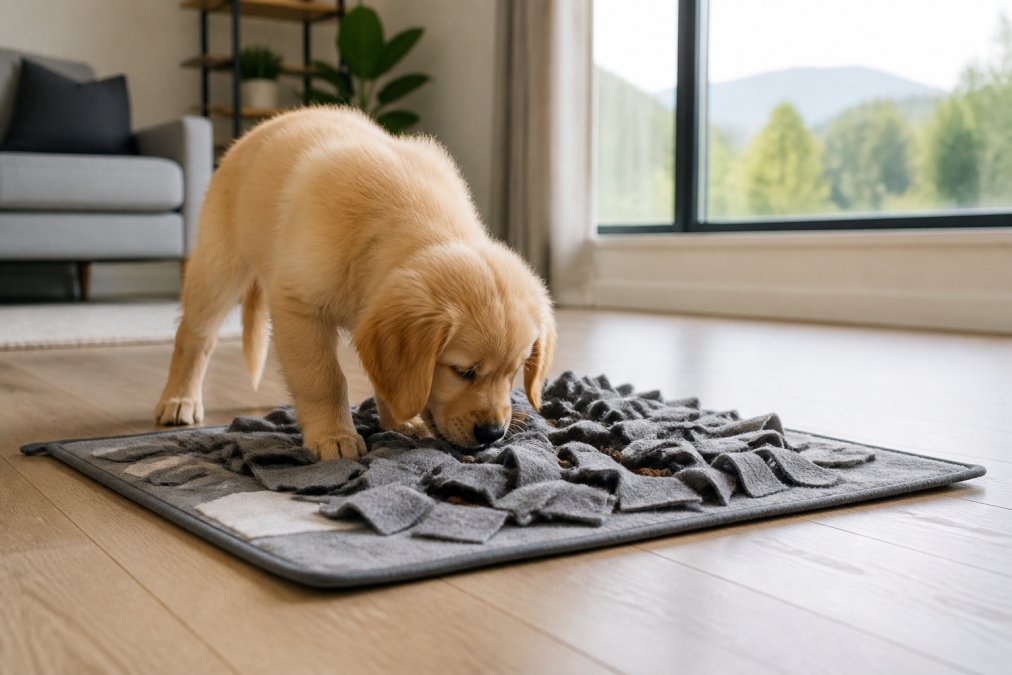
The most effective options include the snuffle mat, which hides treats between its folds and activates the natural instinct for foraging; the lick mat, ideal for short sessions before leaving because licking releases relaxing endorphins; and the automatic food dispenser, which structures meals when you are not there. At Farmina Pet Care, they confirm that the growing use of interactive toys and dispensers reduces stress during absences. In My Shop 4 you will find options such as the Dog Snuffle Mat for $16.99 or the Pet Lick Mat for $9.99, simple tools.


Gradual training in solitude: the 5-minute protocol
The 5-minute protocol is the basis of solitude training, but its effectiveness depends on how you implement it and how you measure progress. This section gives you the complete protocol with objective evaluation criteria.
Prior preparation: the deciding factor for success
Before each training session, follow this sequence:
- Physical exercise: 15-20 minutes of active play or a walk.
- Elimination: make sure they have relieved themselves.
- Mental stimulation: 5 minutes of basic obedience training to tire them out mentally.
- Hydration and comfort: fresh water, appropriate temperature, and their safe zone prepared with toys.
The step-by-step protocol with progression criteria
| Step | Duration | Criteria to advance | Criteria to step back |
|---|---|---|---|
| 1 | 5 minutes | Calm or sleeping in 3 consecutive sessions | Continuous vocalization for more than 2 minutes |
| 2 | 10 minutes | Calm in 2 consecutive sessions | Escape attempts or inappropriate elimination |
| 3 | 15 minutes | Calm in 2 consecutive sessions | Panting or drooling upon return |
| 4 | 20 minutes | Calm in 2 consecutive sessions | Vocalization that does not cease in 5 minutes |
| 5 | 30 minutes | Calm in 2 consecutive sessions | Any sign of intense distress |
| 6 | 45 minutes | Calm in 2 consecutive sessions | Regression in previous steps |
| 7 | 60 minutes | Calm in 2 consecutive sessions | Signs of stress upon return |
Each session must end with the puppy calm. If you return and find them distressed, you have made the duration too long. Reduce it to half the previous duration and maintain that level for 3-4 days before attempting to increase again.
Using monitoring cameras: how to evaluate without interfering
Monitoring technology is an underutilized tool in preventing separation anxiety. A camera allows you to distinguish between what the puppy is actually doing and what you imagine they are doing. The patterns you should observe are:
Calm behavior (progress):
- Falls asleep in the first 5-10 minutes
- Plays with their toys intermittently
- Changes position several times without vocalizing
- Stays in their safe zone without attempting to escape
Anxious behavior (setback):
- Continuous vocalization that does not cease
- Repetitive behavior (circling, licking paws)
- Attempts to escape the area (scratching doors or walls)
- Excessive panting without having exercised
- Inappropriate elimination in an already house-trained puppy
Interpreting the data: what the recording really tells you
After each session, review the full recording and note:
- Time until calm: if it takes more than 10 minutes to settle, the time left alone is excessive for their current level.
- Vocalization pattern: do they cry at the beginning and then go quiet, or do they cry intermittently throughout the entire absence? The first pattern is normal; the second indicates sustained anxiety.
- Timing of vocalization: if they cry only in the first 2-3 minutes and then fall asleep, they are expressing a brief protest, not anxiety. If the vocalization begins at 10-15 minutes, the puppy has exhausted their capacity for self-control at that point.
This objective analysis allows you to adjust the protocol with precision. For example, if you discover that your 12-week-old puppy is calm for 12 minutes but begins to get distressed at minute 13, your next session should last 10 minutes, not 15.
The mistake of interactive cameras with treat dispensers
Some owners use cameras that dispense treats remotely when the puppy cries. This approach is counterproductive: it reinforces vocalization as a strategy to obtain a reward. If you use automatic dispensers, configure them to release treats at fixed intervals, not in response to anxious behavior.
When the protocol doesn't work: warning signs
If after 3 weeks of consistent practice (2-3 daily sessions) the puppy shows no improvement, or if the signs of distress are intense from the first sessions, do not continue insisting with the same approach. Some puppies have a genetic predisposition to anxiety that requires early professional intervention. The Houston SPCA recommends seeking specialized help when the home protocol does not produce improvements within 2-3 weeks, rather than waiting for the problem to become entrenched.
Anxiety or boredom: how to differentiate and act
Not all destructive behavior is separation anxiety. Boredom and anxiety share symptoms, but require different solutions. A bored puppy destroys various objects, calms down with exercise, and shows no physical signs of stress. A puppy with anxiety focuses on doors and windows, greets you desperately, and may exhibit excessive panting or drooling even after you have returned.
The practical difference is this: boredom is resolved with more exercise and mental stimulation; anxiety requires a desensitization protocol. If your puppy destroys things when left alone but sleeps peacefully at your feet, it is likely boredom. Increase physical exercise, add puzzle toys, and observe if the behavior improves within a week. If it does not improve, or if the signs of stress are intense, we are dealing with a case of anxiety that needs a more structured approach.
When to seek professional help for separation anxiety
The time to turn to a professional is when the home protocol does not work or when the anxiety is severe from the start. For cases of intense anxiety, simple environmental solutions like leaving the radio on are insufficient, according to the Journal of the IAABC Foundation. A professional behavioral medicine approach is required.
Seek help if you observe destructive behavior that puts the puppy at risk, vocalizations that do not cease for hours, escape attempts with a risk of injury, or if the 5-minute protocol shows no improvement after two weeks of constant practice. A veterinary behaviorist or a trainer specialized in behavior modification can design a personalized plan. The San Diego Humane Society documents demonstrable improvements in animal behavior through professional treatment plans tailored to each case.
Preventing separation anxiety in your puppy requires patience, consistency, and the right tools. At Mi Tienda 4, we offer enrichment products such as the Snuffle Mat and the Automatic Pet Feeder for $34.99. Start today with the 5-minute protocol and turn your puppy's solitude into a habit of calm.

Frequently Asked Questions
What are the first symptoms of separation anxiety in a puppy?
The first symptoms include vocalizations such as crying or howling when left alone, excessive panting, drooling, destructive behavior near doors or windows, and inappropriate elimination in the house. A puppy with anxiety usually shows these behaviors in the first 15-30 minutes after you leave, not throughout the day. Detecting these signs early allows for the implementation of a behavior modification plan before the habit becomes entrenched.
What toys help reduce separation anxiety in dogs?
Enrichment toys that stimulate sniffing and chewing are the most effective. A snuffle mat with hidden treats keeps the puppy occupied using their natural foraging instinct. Lick mats with peanut butter or frozen yogurt release calming endorphins. Interactive food dispensers combine feeding with mental stimulation. These toys work best when introduced gradually and associated with positive experiences.
How long can a 2-month-old puppy be left alone?
A 2-month-old puppy should not be left alone for more than 2 hours at a time. Their bladder control is limited, and they need to eat and socialize frequently. The rule of thumb is one hour for every month of age, with a maximum of 8 hours for adults. If you work full days, combine an automatic feeder with an exercise routine before leaving and consider a dog walker or daycare during the first few months.