
Table of Contents
- Initial Preparation: What You Need Before You Start
- Puppy Potty Training: The First Steps
- Basic Dog Commands: Sit, Stay, and Come
- How Long Does It Take for a Puppy to Learn: Realistic Expectations
- Dog Training Accessories That Make the Process Easier
- Common Mistakes to Avoid During Training
- Conclusion: Build a Solid Foundation for Your Puppy
- Frequently Asked Questions
Last updated: September 3, 2026
Initial Preparation: What You Need Before You Start
House-training a puppy step-by-step requires the right space, the appropriate tools, and a clear plan. Designate a specific, quiet training area away from major distractions, where your puppy can focus better.
Gather the essential supplies: high-value training treats (small pieces of cooked chicken, cheese, or special treats), a short 4- to 6-foot leash, and a safe place where your puppy can rest without supervision. The dog snuffle mat for pet enrichment and training from Mi Tienda 4 ($16.99) is excellent for this: it turns mealtime into mental exercise, reducing boredom and anxiety while your puppy learns.

Establish a consistent schedule with short 5- to 10-minute sessions, three or four times a day (avsab.org). Puppies thrive on routine, and consistency matters more than duration. Understand your puppy's developmental stages: weeks 8 to 16 are critical for establishing good habits and socialization (avsab.org). Mentally prepare yourself for patience; training is not a race and reflects individual temperament, not intelligence.
Puppy Potty Training: The First Steps
Potty training is the first real goal for most owners. Start with a predictable schedule: 8- to 12-week-old puppies need to go out after eating, after sleeping, after playing, and before bedtime (6 to 8 times a day).
Take your puppy to the same spot every time. The scent and familiarity encourage your puppy to do their business. Reward immediately after success with a treat and enthusiastic praise. Positive reinforcement is the most powerful tool in dog training.
Handle accidents without punishment. Do not yell, hit, or rub their nose in the accident. Simply clean the area thoroughly with an enzymatic cleaner. Recognize that accidents are normal until 4 or 5 months of age; some do not achieve complete control until 6 months (avsab.org). Patience during this phase prevents creating anxiety in your puppy.
Basic Dog Commands: Sit, Stay, and Come
Basic commands form the communication vocabulary between you and your puppy.
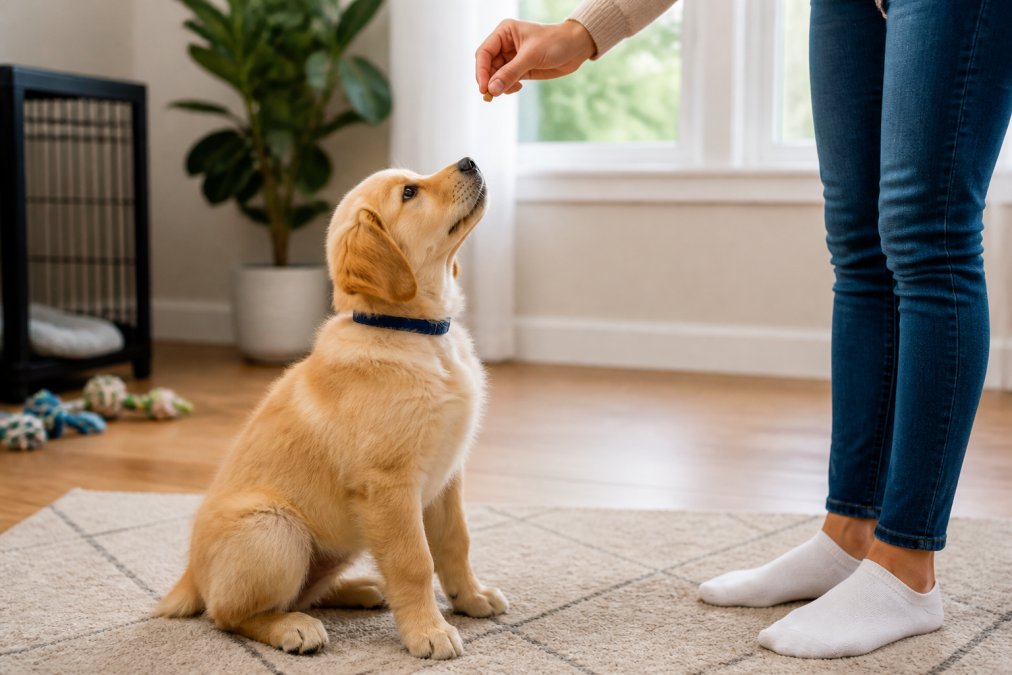
Start with "sit" because it is the easiest. Hold a treat near your puppy's nose, then slowly move it back over their head. When the rear hits the floor, say "sit," give the treat, and praise. Repeat this 5 times, three times a day.
Teach "stay" after your puppy knows "sit." Ask them to sit, then open your hand in front of them and say "stay." Wait 2 seconds, then reward. Gradually increase the time to 5, 10, and 20 seconds. "Stay" requires your puppy to resist the urge to move, teaching fundamental self-control for all future training.
Practice "come" in a safe, enclosed area first. Kneel down, show a treat, say "come" in a happy tone, and reward when your puppy comes to you. Never use "come" for something your puppy does not enjoy, such as a bath or the end of playtime.
Keep sessions short: five to ten repetitions per session is enough. Three 5-minute sessions spread throughout the day teach more than one long session. Use positive reinforcement exclusively. Treats, praise, and fun are the only motivators you need.
How Long Does It Take for a Puppy to Learn: Realistic Expectations
Understanding the learning timeline prevents frustration. Simple commands like "sit" are usually learned in 3 to 7 days with consistent practice. "Stay" takes longer, typically 2 to 4 weeks. "Come" can take several weeks because it competes with other impulses.
Potty training is the slowest. Most puppies show consistent reliability between 4 and 6 months of age. Some do not achieve complete control until 7 or 8 months. This depends on the maturity of your puppy's nervous system, not your training ability.
Early socialization requires consistent exposure between weeks 3 and 16 of life. During this critical period, your puppy is learning what is safe. Each new positive experience reduces anxiety and fear in adulthood.
Recognize individual differences. Some puppies are naturally obedient; others are independent by nature. These differences are temperament, not defects. Consistency shortens the timeline: an owner who practices three times a day will see faster results than one who practices once a week.
Dog Training Accessories That Make the Process Easier
The right tools make training easier and more effective. A 4- to 6-foot leash is the most important accessory. Choose one made of soft material, not a retractable leash, which does not offer sufficient control during training.
Training treats should be small, soft, and high-value. Small treats (pea-sized) allow for multiple repetitions without filling the puppy up. Consider the pet lick mat and feeder toy for pets from Mi Tienda 4 ($9.99) as part of your training kit. This accessory slows down feeding and provides mental stimulation through licking, which releases calming endorphins.

A well-fitted collar or harness is essential. Collars should be snug enough so they don't slide over your puppy's head, but loose enough to fit two fingers underneath. Harnesses offer more control and are better for puppies that pull.
A safe place, such as a puppy playpen or a training crate, is invaluable. A puppy in a crate cannot have an accident in the house or chew something dangerous. The crate also speeds up potty training because puppies naturally do not want to go to the bathroom where they sleep.
You don't need expensive toys. Rope toys, tennis balls, and chewable rubber toys are sufficient. What's important is that your puppy has something safe to chew.
Common Mistakes to Avoid During Training
The most common mistake is expecting too much too soon. Puppies are babies whose brains are still developing. Setting realistic expectations based on age prevents frustration.
Using punishment is another critical mistake. Yelling, hitting, or rubbing your puppy's nose in accidents teaches nothing but fear. Punishment creates anxiety, which often worsens behavioral problems.
Inconsistency is a mistake many owners don't recognize. Rules must be consistent every day, with all family members. Training with distractions present is a technique error. Start in a quiet and controlled environment. Add distractions only after your puppy demonstrates understanding.
Skipping socialization is a long-term mistake. Puppies not exposed to new people, places, and experiences during weeks 3 to 16 often develop fear and anxiety in adulthood. Using retractable leashes during training is a tool error that does not offer the necessary control.
Conclusion: Build a Solid Foundation for Your Puppy
How to train a puppy at home step-by-step requires patience, consistency, and the right tools. Initial preparation, structured potty training, basic commands taught with positive reinforcement, and realistic expectations form the foundation of a well-behaved adult dog.
Quality dog training accessories, such as the dog snuffle mat for pet enrichment and training ($16.99) and the Pet Lick Mat and Feeder Toy for Pets ($9.99) from Mi Tienda 4, make the process easier by providing mental stimulation and behavioral control.
Avoid common mistakes: unrealistic expectations, punishment, inconsistency, and lack of socialization. The time you invest now in consistent and patient training will save you months of behavioral problems in adulthood. A well-trained puppy is a safe, confident, and happy puppy. Start today with Mi Tienda 4 and get the accessories you need to succeed.
Frequently Asked Questions
At what age should I start training my puppy?
You can start basic training between 8 and 12 weeks of age. At this age, puppies have the cognitive capacity to understand simple commands and respond to positive reinforcement. The first few weeks are crucial for establishing routines, socialization, and hygiene habits that will form the basis of adult behavior.
How much time per day should I spend on my puppy's training?
Spend 5-10 minutes in short sessions, several times a day. Puppies have limited attention spans, so multiple brief sessions are more effective than one long one. Combine this with play, socialization, and mental stimulation. As they grow, you can gradually increase the duration to 15-20 minutes.
What are the first steps to training a puppy?
Start by establishing a consistent daily routine for feeding, walks, and rest. Teach the puppy's name and response to basic calls. Implement potty training immediately. Use positive reinforcement with treats and praise. Socialize the puppy with people, other dogs, and safe environments. Patience and consistency are key at every stage.
What should I do if my puppy bites during play or training?
Nipping is normal behavior in puppies. Provide safe chew toys and redirect nipping toward them. When they bite your hand, remove attention immediately. Use positive reinforcement when they play appropriately. Ensure the puppy has enough physical and mental stimulation. If the behavior persists, consult a professional trainer.
Puppy training is a journey, not a destination. Some days will be frustrating. Others will be incredibly rewarding. What matters is consistency and patience. With the right tools from Mi Tienda 4 and a structured approach, any owner can successfully train their puppy at home. Try it for FREE today and discover how our products can transform your training experience.
This article was written using GrandRanker