
Table of Contents
- Why a puppy harness is an investment in their health
- Types of puppy harnesses: which one suits your dog?
- The difference between chest and back harnesses: when to use each
- How to measure a dog for a harness: step-by-step guide
- No-pull harnesses for puppies: solution or quick fix?
- Materials and safety: what to look for in a harness for your puppy
-
Common mistakes when choosing your puppy's first harness
- The "one-size-fits-all" mistake for the entire growth phase
- The mistake of not planning for sizing up
- The mistake of ignoring the biomechanics of the developing shoulder
- The mistake of not measuring chest girth with every change
- The mistake of not checking the harness adjustment range
- The mistake of not considering the teething stage
- The golden rule: the right harness is a process, not a purchase
- Conclusion: the best harness is the one that grows with your puppy
- Frequently Asked Questions
Last updated: September 9, 2026
Choosing the first puppy harness is one of the most important decisions during their first few months, and a guide to choosing the best puppy harness must prioritize joint health. An ill-fitting or low-quality harness can lead to developmental problems that manifest years later.
Why a puppy harness is an investment in their health
Puppies have open growth plates until about 12-18 months, depending on the breed. A collar that puts pressure on the neck can affect the trachea and cervical spine at a critical point in development. This is why dog training experts recommend H or Y models for their ergonomic design, which avoids pressure on sensitive areas—check out Guau and Cat's dog training guides. Excessive pulling with a collar can also contribute to eye problems due to increased intraocular pressure.
The harness distributes pulling force across the chest, protecting the cervical vertebrae, and facilitates positive reinforcement training from day one.
Types of puppy harnesses: which one suits your dog?
There is no universal harness. Each design serves a different need, and understanding the difference will save you money and frustration.
H-harness and Y-harness: the ergonomic choice for daily use
H and Y harnesses are most recommended for daily walks with puppies. Their anatomical design leaves the shoulder joint free, allowing for natural movement without friction. Nylon webbing and breathable neoprene prevent skin irritation—see Patitasco's material recommendations. They are ideal for dogs that already walk without pulling, as they offer comfort without the need for corrective control. Look for models with reinforced stitching and safety buckles that don't rub against the armpits.
Norwegian harness and chest harness: for puppies that need more control
The Norwegian harness, also known as a chest harness, surrounds the neck and chest with a continuous piece. It offers more control but can restrict movement if not adjusted correctly. It is useful for very energetic puppies or large breeds, but it is not the best choice for long walks due to potential friction in the armpit area.
The difference between chest and back harnesses: when to use each
The key difference is the attachment point: chest harnesses have a front ring, while back harnesses have a ring on the dorsal area. A chest harness is the right tool for puppies that pull, because by attaching the leash to the front, the dog turns gently toward you when it tries to forge ahead. The back harness is for dogs that already walk properly.
| Harness Type | Best For | Attachment Point | When to Use |
|---|---|---|---|
| H/Y Harness | Ergonomic daily walking | Back | Dogs that don't pull |
| Norwegian Harness | Additional control | Back and chest | Large or energetic puppies |
| No-pull Harness | Pulling correction | Chest (front) | Training, temporary use |
| Pulling Harness | Canine sports | Back, padded | Adult dogs, not puppies |
How to measure a dog for a harness: step-by-step guide
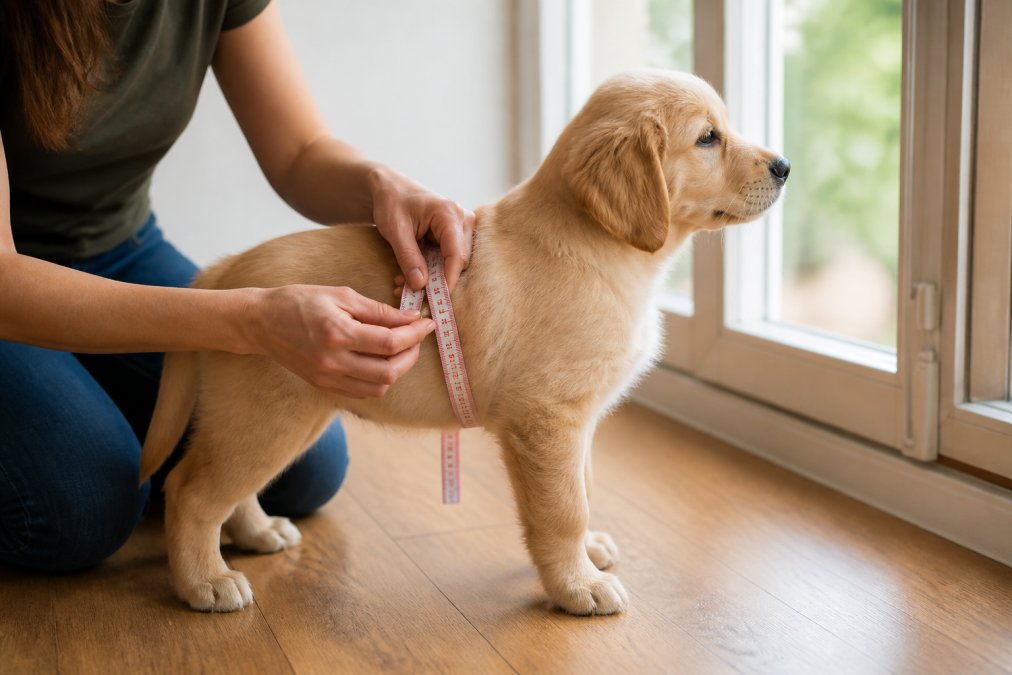
Measuring correctly is the most skipped step and the one that prevents the most problems. You need a flexible measuring tape and a calm puppy.
- Measure chest girth: wrap the tape around the widest part of the chest, just behind the front legs. It should be snug but allow you to slide a finger underneath.
- Measure neck circumference: pass the tape around the base of the neck, where the fur ends.
- Weigh your puppy: weight is a crucial indicator because breeds vary in bone density.
- Consult the manufacturer's size chart: every brand fits differently; do not assume size "M" is universal.
- Adjust and verify: put the harness on and check that it doesn't slide or squeeze. It should allow full shoulder movement.
- From 8 to 16 weeks (2-5 kg for small breeds, 5-10 kg for medium breeds): a lightweight nylon harness with chest and neck adjustments. This harness will likely only last 6-8 weeks, so don't invest in the most expensive model.
- From 4 to 7 months (5-10 kg for small breeds, 10-20 kg for medium breeds): a harness with more padding and additional adjustment points. This is where material quality matters more, because the puppy is already pulling harder.
- From 7 to 12 months: definitive harness, ideally with a front and back ring to transition to adult walking.
No-pull harnesses for puppies: solution or quick fix?
No-pull harnesses with a front ring are useful tools, but they are not the definitive solution for pulling behavior. Some dog trainers warn that they should be evaluated with caution, as if used as the only method without training the walk with positive reinforcement, the dog can get used to the pressure and keep pulling—see Masqueadiestramiento's analysis. The front ring works because it shifts the dog's center of gravity, but it is a mechanical aid, not training. Combine it with short sessions of positive training: reward loose-leash walking and stop when there is tension.
A well-designed no-pull harness, like the Reflective No-Pull Dog Harness from Mi Tienda 4, distributes pressure evenly across the chest instead of the neck, reducing the risk of choking and cervical strain during walks. Its 360° reflective tape adds road safety for dawn or dusk walks, and the breathable nylon keeps the puppy comfortable even in warm climates.

Materials and safety: what to look for in a harness for your puppy
Material quality determines durability and comfort, but for a growing puppy, it also influences skin health and body temperature regulation. A cheap harness can wear out in weeks, leaving rough seams that irritate the skin.
High-density nylon vs. polyester: they aren't the same
High-density nylon (generally 600D or higher) is the standard for mid-to-high quality harnesses. It resists abrasion from dragging on asphalt and chewing from teething puppies. Polyester is softer to the touch but frays faster when the dog pulls hard. For a puppy still learning to walk without pulling, 600D nylon offers the best balance between strength and flexibility.
Neopreno y malla: breathability with nuances
Padded neoprene distributes pressure on the sternum, but not all are the same. 3mm pads are suitable for temperate climates; 5mm pads can cause overheating in thick-coated breeds or warm climates. Breathable mesh is superior in summer because it allows for air circulation, but it offers less cushioning. Many mid-range harnesses combine both: mesh on the sides and neoprene on the chest.
The invisible problem: friction dermatitis
Constant friction from a rough material against a puppy's armpit can cause contact dermatitis, especially in sensitive-skinned breeds like French Bulldogs or Boxers. An early sign is redness or hair loss in the armpit after walks longer than 20 minutes. To prevent this, look for harnesses with flat-lock seams and check that the inner edge has no exposed labels or rivets.
Structural safety: what you don't see matters
Quick-release buckles should be made of polyacetal (POM) or reinforced nylon, not standard ABS plastic that becomes brittle in the cold. Attachment rings should be welded stainless steel, not chrome-plated metal that can rust. A common failure point in cheap harnesses is the connection between the webbing and the ring: if sewn with low-tenacity thread, it will tear under repeated stress. Look for double or triple zigzag stitching at that point.
Reflectivity: beyond the shine
Reflective elements are not all the same. 360° reflective tape (like that on the Mi Tienda 4 harness) reflects vehicle light in all directions, whereas simple reflective patches are only visible from one angle. For dawn or dusk walks, 360° reflectivity is significantly safer. Verify that the reflective material is washable: some lose their capacity after several washes.
Maintenance that extends service life and protects the skin
A harness accumulates saliva, dead hair, dust, and mites that can cause dermatitis or odors. Hand-wash the harness with warm water (max 30 °C) and mild soap every two weeks during the first few months. Do not use bleach or fabric softener: the former degrades the nylon and the latter leaves a residue that can irritate the skin. Air dry away from direct sunlight, because UV rays degrade neoprene elastomers and the color of the webbing. If it has metal parts, dry them immediately to prevent rust.
Common mistakes when choosing your puppy's first harness
The most frequent mistake is buying a harness "with room to grow." A loose harness allows the dog to escape or causes the harness to rotate, leading to friction in the armpits. But there is a deeper error that almost no guide mentions: ignoring the puppy's growth stages and their impact on joint biomechanics.
The "one-size-fits-all" mistake for the entire growth phase
A puppy does not grow linearly. Between 8 and 16 weeks, most breeds gain between 5% and 10% of their body weight per week. A harness that fits perfectly at week 10 may be compressing the shoulder by week 14. Compression of the scapulohumeral joint during this phase can alter the puppy's gait pattern.
The mistake of not planning for a size change
Instead of buying a "big" harness in the hope that it will last for months, plan a two- or three-harness system based on the puppy's weight:
The mistake of ignoring the biomechanics of the developing shoulder
Puppies have open growth plates in the proximal humerus until approximately 10-12 months in medium breeds and 14-18 months in large breeds. A harness that restricts natural shoulder movement, for example, a strap that crosses directly over the scapulohumeral joint, can interfere with the development of that plate. H-shaped and Y-shaped harnesses leave this joint free because the side strap passes behind the shoulder, not over it. Verify that the harness does not have a strap that passes directly over the point where the shoulder meets the torso.
The mistake of not measuring the chest girth with every change
Another common mistake is choosing a size based only on weight without measuring the chest girth. Deep-chested breeds, such as Greyhounds or Boxers, need very different sizes than those with a robust build of the same weight, such as a Bulldog or Pug. Measure the chest girth every two weeks during the first four months. If it increases more than 2 cm since the last measurement, check the fit of the current harness.
The mistake of not checking the harness adjustment range
Each harness has a specific adjustment range (e.g., chest 35-45 cm). When the puppy is at the upper end of that range, the harness no longer offers an optimal fit: the buckles are at their limit and the harness can rotate. A good indicator is marking the current buckle hole with a marker. If you need to loosen it more than two positions in the same month, switch to the next size.
The mistake of not considering the teething stage
Between 4 and 6 months, puppies lose their baby teeth and chew on everything they find to relieve gum inflammation, including harness straps. A low-density nylon strap harness can be punctured by developing molars. If your puppy is teething, choose a harness with high-density nylon webbing (600D or higher) and avoid models with rubber edges that can be torn off and swallowed.
The golden rule: the right harness is a process, not a purchase
Choosing the right harness is not a one-time event, but a continuous process during the first 12 months. The best puppy harness is one that combines ergonomics, quality materials, and precise adjustment, and which you can adapt as your dog grows. Keep a simple log: date, weight, chest girth, and current buckle setting. With that record, you will know exactly when to adjust or replace the harness before it causes a development issue.
Conclusion: the best harness is the one that grows with your puppy
Choosing the right harness is not a one-time event, but a continuous process during the first few months. The best puppy harness is one that combines ergonomics, quality materials, and precise adjustment, and which you can adapt as your dog grows. Regular cleaning also prolongs its lifespan: hand-wash the harness with warm water and mild soap every two weeks to avoid the buildup of dirt that can irritate the skin.
At Mi Tienda 4, we have selected the Reflective No-Pull Dog Harness for its ergonomic design, customizable fit, and reflective safety, all at a competitive price of $18.99. Try it and see the difference in your daily walks from the first week.
Frequently Asked Questions
At what age can a puppy wear a harness?
You can start using a harness from 8 weeks old, once the puppy is at home and has had its first vaccinations. The important thing is that it is lightweight, adjustable, and does not restrict movement. Check the fit every week, as puppies grow very quickly. A harness that is too tight can cause irritation, and one that is too loose allows them to escape. The key is supervision and patience during the first trials.
How do I know what size harness fits my puppy?
To know the correct size, you must measure your puppy's chest girth, which is the widest part behind its front legs. Use a flexible measuring tape and leave room for two fingers between the tape and its body. Each manufacturer has its own size chart, so always compare your measurements with the product guide. If your puppy is between two sizes, choose the larger one so it lasts longer.
Is a harness or a collar better for a puppy?
For a puppy, a harness is almost always the better option. A collar can put pressure on the neck and trachea, especially if the dog pulls on the leash. The harness distributes pressure across the chest and back, protecting its cervical spine and allowing for safer development. Additionally, the harness gives you more control without causing harm. The collar can be kept for identification, but the leash should always be attached to the harness.
How do I stop my puppy from pulling on the leash with a harness?
The harness is not magic: it prevents the puppy from getting hurt, but the training is up to you. Use a harness with a front ring, because when the dog pulls, it turns towards you, breaking the momentum. Combine this with positive reinforcement training: every time it walks by your side without pulling, reward it with a treat or praise. Change direction when it pulls to teach it that pulling doesn't take it where it wants to go. Daily consistency is key.