
Table of Contents
- Why your puppy needs daily mental stimulation
- Scent games for dogs at home: the most effective mental exercise
- Interactive toys for puppies you can use today
- How to tire out an energetic puppy: 15-minute routine
- Mental stimulation exercises for puppies at home: step-by-step weekly plan
- Common mistakes and how to avoid them
- Frequently Asked Questions
Last updated: September 11, 2026
Why your puppy needs daily mental stimulation
A puppy without enough mental stimulation finds its own ways to entertain itself, and they almost always involve your furniture, your shoes, or table legs. Mental stimulation engages a dog's mind through scent, problem-solving, and self-control, and is just as important as physical exercise for a balanced dog.
According to the Houston SPCA environmental enrichment guide, healthy stimulation improves mental health and combats boredom in pets, much like it does for humans.
Fifteen minutes of mental work tires a puppy out as much as half an hour of running, and you can do it indoors regardless of the weather or the size of your yard (houstonspca.org).
Boredom or separation anxiety: how to tell them apart
The difference between boredom and separation anxiety determines whether you need more games or an emotional management plan. A bored puppy destroys things due to a lack of options; one with anxiety destroys things only when you leave, accompanied by barking, panting, excessive drooling, or attempts to escape.
Time patterns will give you the answer:
- Boredom: chewing happens at any time of day, even when you are home
- Anxiety: destruction is concentrated within the first 30 minutes after you leave
- Boredom: the puppy settles down on its own and sleeps without issue
- Anxiety: it does not eat or rest while you are away
If you suspect separation anxiety, mental stimulation helps, but it does not replace a gradual desensitization plan. Start with short departures and food-dispensing toys that last longer than your absence.
Scent games for dogs at home: the most effective mental exercise
Scent play is the activity that exhausts a puppy mentally the most because it activates their natural instinct to search. A dog that uses its nose processes information intensely, and that cognitive load leaves it satisfied in just a few minutes.

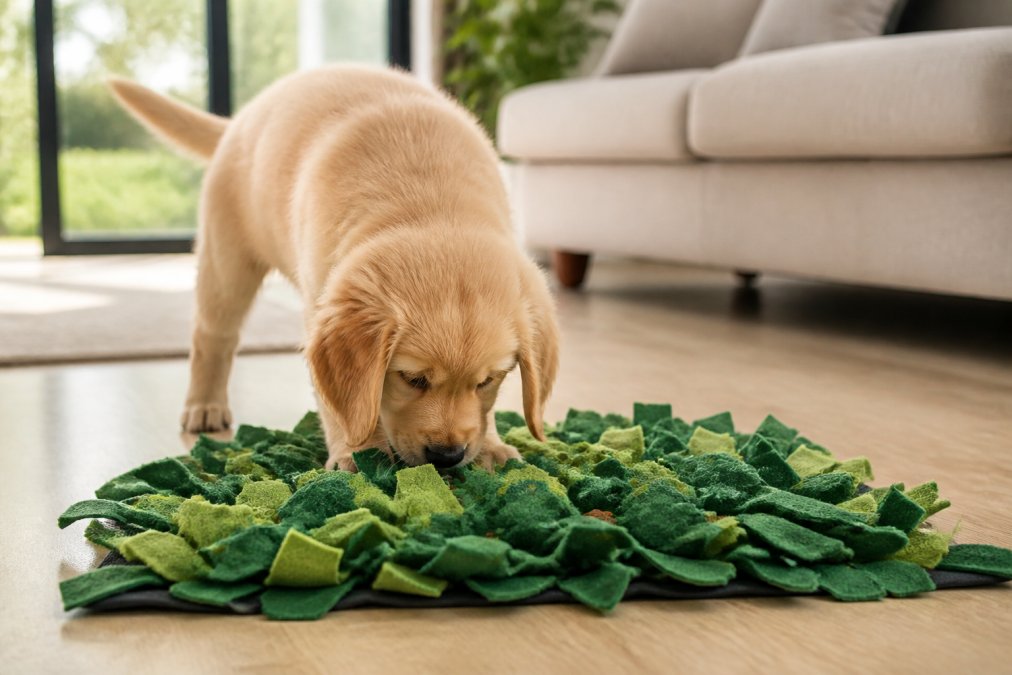
How to get started with indoor treat searching
Indoor treat searching is the ideal starting point for any puppy. Follow these steps:
- Place your puppy in another room or ask it to "wait"
- Hide 5 to 8 small treats in a single room, at first in plain sight
- Release the puppy and say "Find it!"
- Calmly celebrate each found treat
- Increase the difficulty by hiding the treats behind objects or under edges
A snuffle mat like the Mi Tienda 4 Dog Snuffle Mat turns this activity into a ten-minute game without having to hide anything: the dog works its nose through the fabric strips to extract the food. At $16.99, it is one of the most affordable ways to tire out a puppy indoors.
Interactive toys for puppies you can use today
Interactive puppy toys are objects designed for the dog to work for its food or solve a challenge. Unlike a stuffed toy, they require mental action, which is why they truly tire them out.
| Toy | How it works | Best for | Price |
|---|---|---|---|
| Snuffle Mat | Hides food between fabric strips | Boredom chewing | $16.99 |
| Lick Mat | Spread paste or puree to lick | Anxiety and relaxation | $9.99 |
| 4-layer puzzle bowl | Maze with removable levels | Fast eaters | $12.99 |
| Recordable buttons | Dog presses to communicate | Self-control and bonding | $19.99 |
The Mi Tienda 4 Pet Lick Mat is the most useful for calm moments: licking releases endorphins that relax the puppy, so it works before leaving it alone or after an intense session. The 4-layer puzzle bowl turns daily feeding into a challenge and slows down puppies that gulp their food in seconds.

How to tire out an energetic puppy: 15-minute routine
Tiring out an energetic puppy doesn't require an hour of play, but rather a routine that combines scent, movement, and self-control in that order: scent focuses them, movement discharges their energy, and self-control brakes them before they become overstimulated.
Why the scent-movement-self-control order works
Scent is a dog's dominant sense and activates the parasympathetic nervous system when they search consistently: a puppy that starts by sniffing enters with a stimulated mind but a calm body. If you start with intense physical play, they reach the scent phase with their sympathetic nervous system triggered and cannot concentrate.
Movement in the middle phase discharges accumulated energy, it does not wear the dog out. Short tosses, controlled tug-of-war, or chasing a toy work because they involve starts and stops, not continuous running: a puppy that runs non-stop for ten minutes becomes overstimulated and takes longer to calm down.
Self-control at the end consolidates the effect: asking for "sit," "stay," and a wait before releasing the toy forces the puppy to inhibit its impulse when it is most excited. That inhibition carries over into daily life: a dog that waits before grabbing a toy also waits before chewing on furniture.
15-minute basic routine
- Minutes 1-5, scent: hide treats or use the snuffle mat. Start with strong-smelling treats and low difficulty.
- Minutes 6-10, movement: short tosses, controlled tug-of-war, or chasing a toy. Alternate 20-30 seconds of activity with 10-15 seconds of rest.
- Minutes 11-13, self-control: ask for "sit," "stay," and wait before releasing the toy. Repeat 3-5 times.
- Minutes 14-15, calm: offer a lick mat or a chew toy to lower activation.
Ending with calm prevents the puppy from becoming overstimulated and continuing to chew furniture: a dog that finishes licking or chewing on something safe falls asleep faster.
How to adjust the routine based on age
The same sequence doesn't work the same at 2 months as it does at 6:
- 2 to 3 months: 5-7 minute sessions, two or three times a day. The scent phase must be very easy (treats in plain sight) and self-control is limited to "sit" for 1-2 seconds. Attention span at this age is minimal.
- 3 to 4 months: 10-minute sessions, two or three times a day. You can now hide treats behind objects and ask for 3-5 second stays.
- 4 to 6 months: 15-minute sessions, twice a day. Introduce the puzzle bowl as a feeder and 5-10 second waits before releasing the toy.
If the puppy loses interest halfway through the routine, it's not stubbornness: the session is too long or difficult for its stage. Shorten it and try increasing it again in a few days.
Signs of overstimulation
An overstimulated puppy doesn't get more tired: it gets out of control. Signs:
- Intenser chewing immediately after the session
- Excessive panting without having run much
- Inability to respond to "sit" commands it had already mastered
- Dilated pupils and erratic movements
If these appear, stop the movement phase and go straight to calm with a lick mat. The next session should be shorter.
Proprioception and olfactory stimulation exercises at home shows how self-control and scent work combine to develop a puppy's cognition, something that confirms what we see daily.
Mental stimulation exercises for puppies at home: step-by-step weekly plan
A weekly plan prevents stimulation from becoming repetitive and losing its effect: puppies adapt quickly and variety is part of the exercise. This four-week plan scales the difficulty gradually and is designed for a 2 to 4-month-old puppy.
Week 1: recognition
- Days 1-3: search for treats in plain sight in a single room
- Days 4-5: introduce the snuffle mat with visible food
- Days 6-7: short sessions of "sit" and "stay" before eating
Week 2: increasing difficulty
- Hide treats behind objects and under edges
- Alternate snuffle mat with lick mat each day
- Add a puzzle toy to one of the meals
Week 3: combination
- Full 15-minute routine, three times a day
- Introduce the puzzle bowl as the main feeder
- Practice longer waits before releasing the toy
Week 4: consolidation
- Vary the hiding spots each day to maintain interest
- Add a second room to the treat search
- Reduce the duration if the puppy loses interest and increase it again later
What to do if the puppy ingests a material
During teething, a puppy doesn't just chew on furniture: it may tear off and swallow pieces of varnish, wood, foam, or fabric. Most modern interior varnishes are water-based and have low toxicity once cured, but a piece of wood or foam can indeed cause an intestinal obstruction.
Signs that the puppy has ingested something they shouldn't have:
- Repeated vomiting or retching without expelling anything
- Lack of appetite or refusal to drink water
- Dark stools, stools with blood, or visible fragments
- Swollen or painful abdomen when touched
- Lethargy or inability to defecate
If you notice any of these signs, call your veterinarian or an emergency service. Do not induce vomiting yourself: an object with sharp edges can damage the esophagus on the way up. Have the name of the ingested material and the estimated size of the piece ready.
Safe vs. toxic materials in the home
Before leaving the puppy alone in a room, check what is at its height:
Generally safe if ingested in small pieces:
- Untreated and unpainted wood
- Cotton fabric without industrial dyes
- Natural cotton rope (supervised, as it can fray)
Risky:
- Varnishes, lead-based paints (common in antique furniture), and sealants
- Foam filler from sofas and cushions, which can cause obstruction
- Hard plastics that splinter
- Electrical cords and cables
- Houseplants such as peace lily, aloe vera, or philodendron
Dog-proofing is not just about putting shoes away: check the puppy's height, as at 3 months old it can reach everything less than 30 cm from the floor and everything it can climb.
How the plan evolves from 4 to 6 months
From 4 months on, the puppy has mastered the basic mechanics and the plan should move to the next level:
- Replace one snuffle mat session with a search in two rooms
- Add a second puzzle toy with more removable pieces
- Introduce 10-second waits before releasing the toy
- Start varying the order of the routine so the puppy does not anticipate
The recordable buttons from My Shop 4 are a good fit starting from week 3, once the puppy has mastered self-control: recording words like "walk" or "water" and teaching it to press them turns training into real communication.

Common mistakes and how to avoid them
The most frequent mistake is relying on only one type of game: a puppy that only does treat searching gets bored in two weeks and goes back to the furniture. Variety sustains interest in the long term.
Other mistakes worth avoiding:
- Leaving toys available all day. The novelty is lost. Put them away and take them out only during sessions.
- Using stimulation as a punishment. If the snuffle mat only appears when you leave, the puppy associates it with your absence.
- Ignoring material safety. Always supervise chew toys and remove any object with loose parts.
- Skipping the calm phase. Finishing with active play leaves the puppy overstimulated.
- Expecting results in one day. Behavior changes take weeks of consistency.
Constant supervision remains the most underestimated tool. No toy replaces your presence during the first few weeks of training.
Frequently Asked Questions
How can I stop my puppy from chewing furniture?
Furniture chewing usually indicates boredom or teething. Offer appropriate chew toys and redirect their attention every time they chew on furniture. Increase mental stimulation with scent games and interactive toys. Constant supervision and positive reinforcement when they chew on the right thing accelerate the habit change.
Why is mental stimulation in puppies important?
Mental stimulation tires your puppy out just as much as physical exercise and reduces boredom, anxiety, and destructive behavior. According to the Houston SPCA (2026), healthy stimulation improves mental health and combats boredom in pets. Devote 10 to 15 minutes a day to scent games or interactive toys to see results.
How much time per day should a puppy play to stimulate its mind?
Two or three sessions of 10 to 15 minutes a day is sufficient for most puppies. The key is quality, not quantity: a well-designed scent game is more tiring than half an hour of throwing a ball. Adjust according to your puppy's energy and stage of development.
What homemade toys help with mental stimulation?
You can use paper rolls with treats inside, cardboard boxes with hidden snacks, or rolled-up towels with food. Interactive toys for puppies, such as level-based puzzles, also work very well. Always supervise the material to prevent ingestion and remove remnants when finished.
A puppy's destructive behavior is almost never resolved with a single trick, but with a constant system of stimulation, exercise, and supervision. At My Shop 4 you will find the tools to build it without complications: the snuffle mat, the lick mat, the 4-layer puzzle bowl, and the recordable buttons, all at a competitive price and shipped to your door. Try it for FREE and discover how fifteen minutes a day changes your puppy's behavior.