
Table of Contents
- Why your puppy chews furniture and how to identify the cause
- Puppy teething stages: what to expect and when it ends
- Toys for teething puppies: how to choose the right ones
- Homemade chew-deterrent spray: recipe and application
- Week-by-week training plan to stop furniture chewing
- Exercise, mental stimulation, and environmental enrichment
- Supervision, puppy-proofing, and environment management
- Common mistakes and what to do if your puppy has ingested material
- Frequently Asked Questions
Last update: September 11, 2026
Why your puppy chews furniture and how to identify the cause
Destructive chewing is rarely an act of rebellion: it is usually a response to teething, boredom, anxiety, or a lack of mental stimulation. Knowing how to teach a puppy not to chew furniture starts with identifying the cause.
According to training guides released in 2026, the habit of chewing furniture is a response to anxiety, boredom, or a lack of physical exercise and mental stimulation, not malice guide on causes of destructive chewing. Experts agree that prevention based on exercise and stimulation is more effective than subsequent correction canine behavior guide.
Separation anxiety vs. boredom: how to tell them apart
The difference lies in when the damage occurs. A bored puppy chews during your normal absences and also when you are home but not interacting. A puppy with separation anxiety chews almost exclusively when you leave, often accompanied by barking, panting, drooling, or attempts to escape.
The distinction changes the plan: boredom is solved with more exercise and interactive toys; separation anxiety requires gradual desensitization to your departures and, in severe cases, veterinary support or help from a certified trainer.
Puppy teething stages: what to expect and when it ends
Teething is the most common cause of chewing between 8 and 20 weeks. Gums hurt, and the puppy seeks relief by gnawing on firm textures: wooden furniture legs are the perfect target.
Teething timeline: what happens and when
The process is not uniform. Milestones observed by most veterinarians in medium-sized puppies:
| Age | What happens | Typical behavior |
|---|---|---|
| 2 to 4 weeks | First baby teeth appear | Minimal, still with mother |
| 6 to 8 weeks | All 28 baby teeth are in | Exploratory chewing of everything |
| 8 to 12 weeks | Incisors begin to fall out | Biting harder, seeks hard textures |
| 12 to 16 weeks | Baby canines and molars fall out | Peak of destructive chewing |
| 16 to 24 weeks | Adult teeth erupt | Intense pain, bleeding gums when chewing |
| 6 to 7 months | Full set of teeth (42 teeth) | Chewing decreases if redirected |
Teething lasts until 6 or 7 months of age. The instinct to chew does not disappear, but it decreases in intensity if you have taught them which objects are acceptable to chew.
Common mistake: expecting it to fix itself over the months. A puppy that never learned to redirect its bite will continue chewing furniture as an adult, but with more force.
Signs teething is going well (and when to worry)
It is normal to see blood spots on a cloth chew toy between weeks 16 and 24, or to find a baby tooth lost during play. It is not normal if there is:
- Heavy or persistent bleeding for more than a few minutes.
- Retained baby teeth at 7 or 8 months (where the adult tooth grows next to the baby tooth, causing crowding).
- Refusal to eat or drink for more than 24 hours.
- Strong bad breath with red and inflamed gums, a sign of gingivitis or infection.
- Tooth fractures from chewing objects that are too hard (cooked bones, antlers, stones).
If any of these signs appear, a vet visit is mandatory: a retained tooth requires extraction to prevent bite issues.
Teething relief protocol
Pain relief is the most effective way to reduce chewing at this stage: a puppy with comfortable gums will not take out its tension on table legs. This three-pronged protocol outperforms any isolated correction:
- Cold: frozen chew toys or a frozen damp towel; the cold numbs inflamed gums. Two or three 10-minute sessions per day.
- Pressure: medium-hardness rubber chew toys that yield under the jaw; constant pressure relieves the dull pain of eruption.
- Distraction: short sessions of structured play (5 to 10 minutes) every time the puppy goes for furniture; redirection works best when the puppy is already tired of chewing.
What to expect when teething ends
By 7 months, most puppies stop chewing due to pain. If the chewing continues, the cause is no longer teething but boredom, separation anxiety, or a learned habit: it's time for a training and environmental enrichment plan, not more teething toys.
Toys for teething puppies: how to choose the right ones
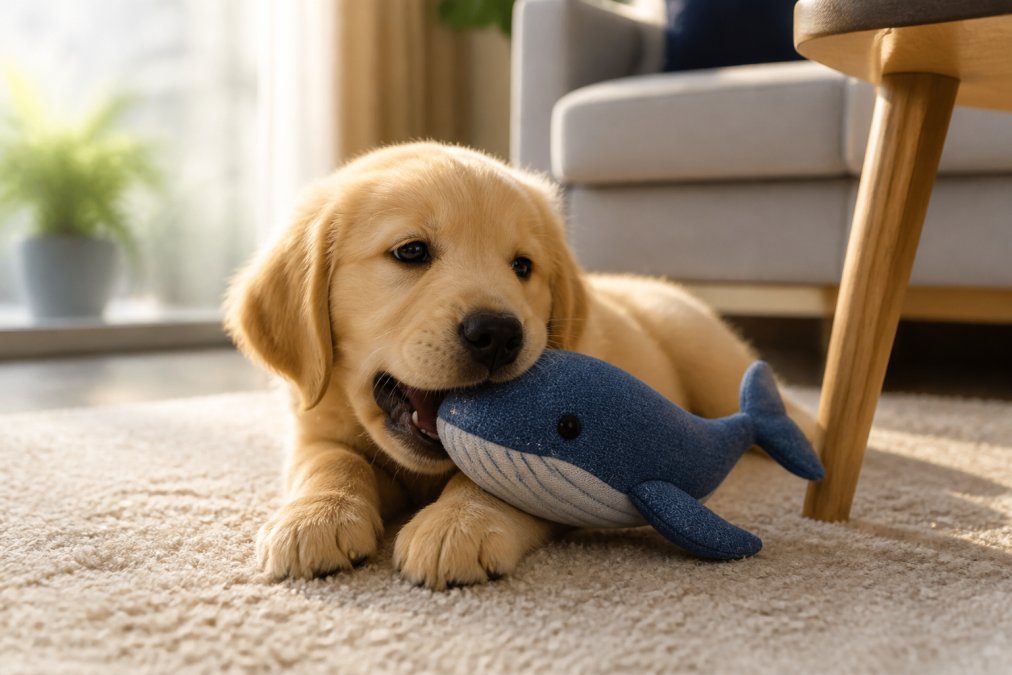
Choosing the right toys for chewing puppies is half the battle. The criteria should be hardness, size, material safety, and ensuring it won't break into pieces that the puppy could swallow.
How to read the label before buying
Most people choose by instinct and discover the problem when the toy is already destroyed. Before paying, check three things:
- Declared material: look for natural rubber, TPR (thermoplastic rubber), or food-grade nylon. If the label doesn't specify the material, it's a red flag.
- Size vs. breed: a "one size fits all" chew toy almost never works. For small breeds (under 20 lbs adult weight), the toy must fit in the mouth without being swallowable; for large breeds, it must be resistant enough not to be broken in the first session.
- Supervision warnings: serious manufacturers state whether the toy requires supervision. A cloth toy with a squeaker almost always does; a hard nylon bone does not.